Malawi Trade Intelligence
This is a project I did for my masters research paper, where I built an intelligence dashboard for Malawi.
The goal is to move beyond surface-level descriptive statistics and generate actionable intelligence across five analytical dimensions: trade concentration, partner and commodity clustering, year-over-year growth dynamics, rolling volatility, and forward-looking market prediction.
Overview
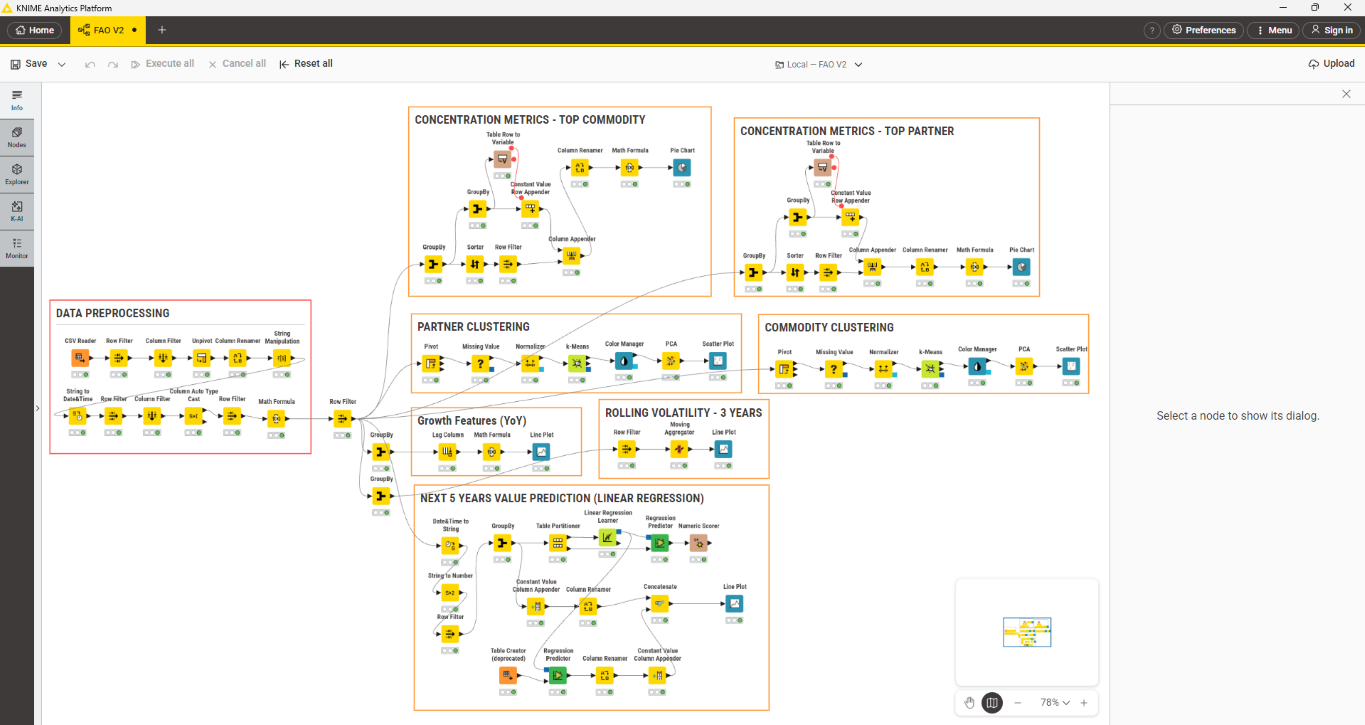
The project was structured as a modular KNIME workflow, with each analytical section receiving a preprocessed data feed from a shared Data Preprocessing branch. This design ensures consistency across all analyses and allows each module to be updated independently.
The following are the main topics I focused on this project :
-
Identify structural concentration - quantify how much of Malawi's export value is carried by a single commodity and a single partner.
-
Reveal natural groupings - use k-Means clustering and PCA to segment both trading partners and commodities into behaviorally similar groups.
-
Track growth trends - compute year-over-year growth rates across the full dataset to identify inflection points and sustained trends.
-
Measure trade risk - apply a 3-year rolling standard deviation to quantify export volatility with the top partner (Belgium).
-
Forecast future performance - train a linear regression model on tobacco export history and project values through 2029.
The case study uses the FAO public dataset to build a reproducible intelligence dashboard that can be applied to any country in the dataset, using descriptive, unsupervised, and predictive analytical techniques. A range of algorithms are used to build the dashboard, these include: k-means clustering, PCA (Principal Component Analysis), and Linear Regression.
The dashboard can be accessed on this link CLICK HERE
Moreover, the code for the project can be found on my GitHub Repository
Overview Of The Singular Value Decomposition Architecture